












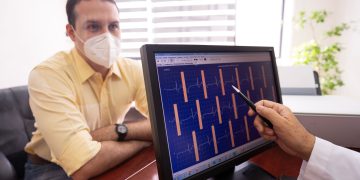





































Grampians Health has begun trialling an artificial-intelligence note-taking tool across its hospital services in Ballarat, working with the University of Melbourne to see whether machine transcription can pull clinicians out of their paperwork and back to the bedside.
The trial pairs the regional health service with the university’s Centre for Digital Transformation of Health, and puts a data-transcription program to work drafting the clinical letters that hospital doctors send to GPs and other providers after a patient is seen.
The pitch is simple. If software can capture and structure a consultation in near real time, correspondence can reach a patient’s GP within hours of a hospital visit rather than days later, tightening the loop on decisions about medication, follow-up and referral.
What is being tested, and why here
Grampians Health head of unit for general medicine in Ballarat, Dr Edward Ritchie, said the program is expected to improve both efficiency and communication, according to reporting by The Moorabool News and trade outlet Pulse+IT.
The choice of a regional service is deliberate. Rural and regional hospitals carry the same documentation load as their metropolitan counterparts but with thinner rosters, so any hour clawed back from typing lands harder.
The scale of that load is not trivial. An Australian study of hospital doctors reported in the Medical Journal of Australia found doctors spend, on average, three hours a day on documentation, the same amount of time they spend directly caring for patients.
Grampians Health and the university frame the tool as a way to chip into that first figure without cutting the second. The stated ambition, per Pulse+IT, is a model that could be lifted into other hospital settings if it holds up.
Early evidence points the same way
The Grampians trial does not sit in isolation. A quasi-experimental pilot published in the ANZ Journal of Surgery tested AI-enhanced dictation in a private colorectal and general surgery clinic in regional Victoria.
The authors, led by G. J. Carmichael, found AI-assisted documentation was associated with shorter clinician-facing documentation time in that outpatient practice, without lengthening consultations.
Their conclusion is measured rather than triumphant. The findings suggest a workflow benefit, the team wrote, but broader evaluation of documentation quality, safety, cost, governance and downstream workforce effects is required before wider rollout can be recommended.
That caution matters, because the technology is already moving faster than the evidence. Australian doctors have adopted so-called AI scribes at speed, well ahead of settled rules on how they should be used.
A national rush, and a regulatory catch-up
The Royal Australian College of General Practitioners published its first formal position on AI scribes in October 2025. Its own survey found the share of Australian doctors using the tools nearly doubled, from 22 per cent in August 2024 to 40 per cent by November 2025.
The college’s guidance rests on three principles: patient consent, clinician responsibility and data privacy. It warns against treating AI-generated notes as final without review, and discourages the most junior GP registrars from leaning on scribes while they are still building clinical-reasoning skills.
Regulators are now moving to close the gap. According to Digital Trends, briefing papers prepared for Senate Estimates in February 2026 saw the federal health department flag privacy and safety risks, with the Therapeutic Goods Administration reviewing whether AI scribes should be classified as medical devices.
The department’s papers noted that some providers offer limited transparency about how patient information is processed, and that clinicians may not realise patient data is being transmitted to cloud servers outside Australia. Ahpra and the Office of the Australian Information Commissioner are also in the frame.
Those concerns cut directly at a hospital trial. Any tool that records a consultation and ships the audio offshore for processing raises questions about sovereignty and consent that a health service, not just a vendor, has to answer.
Why it matters
Regional Australia has a doctor shortage, and every workaround that keeps clinicians in clinics rather than at keyboards has real workforce value. If the Grampians trial shows even a modest, durable time saving, it strengthens the case for regional services adopting tools that metropolitan and private practices are already using.
There is a sovereignty dimension too. Clinical notes are among the most sensitive data a person generates, and the federal warnings about offshore processing land squarely on public health services weighing these tools. A publicly run trial gives Australia a chance to test governance, local data handling and consent in a controlled setting rather than through unmonitored private uptake.
The upside is timelier care and less burnout. The risk is that speed and workforce pressure push adoption past the point where accuracy, consent and data control have been properly nailed down. Grampians Health is trying to do the harder thing: prove the benefit and the safeguards at the same time.
What happens next
The immediate test is whether the tool measurably cuts documentation time in a busy regional hospital without introducing errors into letters that GPs rely on. That is a higher bar than a private clinic pilot, because hospital correspondence feeds directly into community care.
Watch, too, for how the trial handles consent and data location as the TGA finishes its medical-device review. If Grampians Health can show a model that saves clinicians time while keeping patient data governed and onshore, it becomes a template other regional services can copy, rather than another product bought on faith.
For now the results are still coming in. But the direction of travel across Australian health care is clear, and regional Victoria has put its hand up to help work out how it should be done.
Sources: The Moorabool News (Times News Group); Pulse+IT; ANZ Journal of Surgery; RACGP; Digital Trends.


