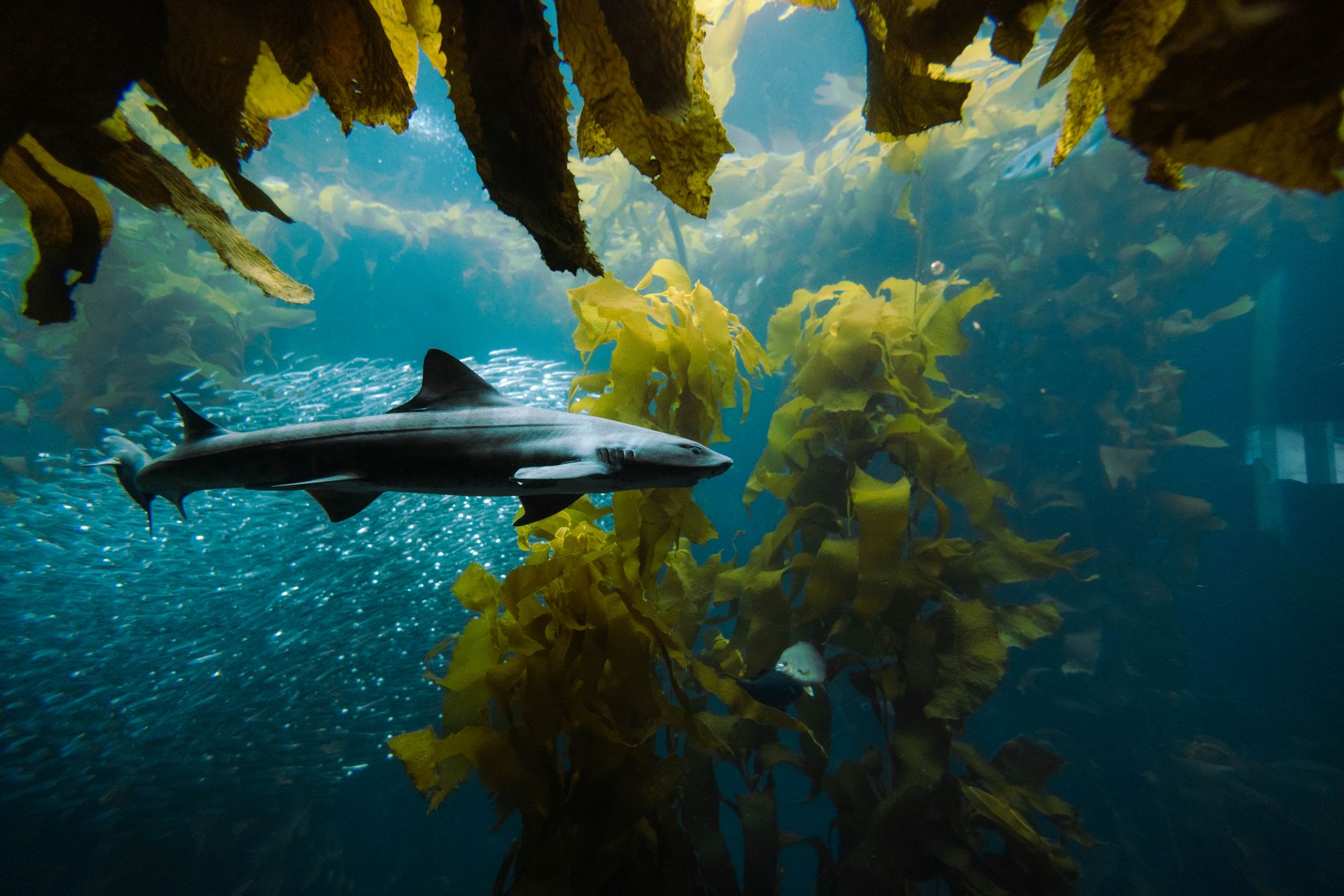
Off the eastern coast of Tasmania, one of the country’s most spectacular marine ecosystems has all but vanished. The towering canopies of giant kelp that once stretched toward the surface like submerged rainforests have retreated by roughly 95 per cent over the past few decades, pushed to the brink by warming waters and the southward creep of the East Australian Current. Now an unusual partnership between one of the world’s largest technology companies and Australia’s national science agency is betting that genomics and artificial intelligence can help bring them back.
According to reporting aggregated through Google News, Google’s AI teams have worked alongside CSIRO to sequence 600 individual giant kelp specimens, a dataset intended to pinpoint the genetic traits that let some plants survive marine heatwaves while their neighbours wither. The idea is deceptively simple: if scientists can read the genome at scale and identify which seaweed carries the markers for heat tolerance, they can selectively breed and propagate those strains, then return them to reefs where the species has collapsed.
Why the kelp is disappearing
Giant kelp (Macrocystis pyrifera) is a keystone species. Its forests shelter rock lobster, abalone, weedy seadragons and countless fish, and they underpin fisheries and dive tourism along Australia’s temperate coast. The problem is temperature. Giant kelp thrives in cool, nutrient-rich water, and the seas off Tasmania are now among the fastest-warming patches of ocean on the planet. As the East Australian Current carries warm, nutrient-poor water further south, the kelp starves and bleaches. The decline has been so severe that in 2012 Australia’s giant kelp forests became the first marine community to be listed as an endangered ecological community under national environment law.
Restoration has been under way for several years, led in large part by researchers at the Institute for Marine and Antarctic Studies in Hobart, who have been hunting for naturally resilient plants and raising them in the lab before outplanting them onto depleted reefs. The painstaking work of finding those rare survivors, however, has been slow. Sequencing 600 specimens and applying machine learning to the results is meant to accelerate that search dramatically, turning a needle-in-a-haystack problem into a data problem.
The case for AI in the water
Supporters of the approach argue that genomics is exactly where computational power earns its keep. A single kelp genome is enormous, and comparing hundreds of them to tease out which variations actually confer heat tolerance is beyond what researchers can do by eye or with a spreadsheet. By training models on the sequenced specimens, scientists hope to predict resilience from a plant’s DNA rather than waiting to see which survive a summer. Marine ecologists working on giant kelp, including Cayne Layton at IMAS, have long described the goal as breeding a kind of “super kelp” that can withstand the conditions Tasmania’s coast will face by mid-century, and a genomic map makes that selective breeding far more precise.
There is also a sovereignty angle that appeals to Australian science. Pairing CSIRO’s marine expertise and sample collection with Google’s computing muscle means the heavy lifting on sequencing and analysis can be done without exporting the problem offshore, and it gives local researchers access to tools they could not easily fund alone.
The sceptics’ view
Not everyone is convinced that technology is the right lever. Conservation scientists have cautioned for years that breeding heat-tolerant kelp treats the symptom rather than the cause. If the ocean keeps warming, even a hardier strain will eventually hit its ceiling, and restoration effort spent on a reef that becomes uninhabitable within a generation is effort wasted. Critics also point to the sheer scale of the challenge: replanting a forest that once covered large stretches of coastline is enormously expensive and labour-intensive, and no amount of clever sequencing changes the economics of getting plants into the water and keeping them there.
There is a quieter concern too about the role of big technology companies in environmental science. Partnerships of this kind bring resources and publicity, but they also raise questions about who owns the resulting data, how long the commitment lasts once the headlines fade, and whether public research agencies become dependent on corporate goodwill for core capability. Those are not reasons to reject the collaboration, but they are reasons to watch how it is governed.
What it means for Australia
The stakes here are not confined to Tasmania. The Great Southern Reef, the interconnected system of temperate rocky reefs that rings the southern half of the continent, is estimated to be worth billions of dollars a year to the national economy through fishing, tourism and the ecosystem services it provides, yet it attracts a fraction of the attention lavished on the Great Barrier Reef. Giant kelp is one of its most visible casualties, and what happens off Tasmania is a preview of the pressure that warming will place on temperate marine life right along the southern coast, from Victoria to South Australia and Western Australia.
For the broader Australian research sector, the project is also a test case for how AI gets applied to environmental restoration rather than productivity or profit. Much of the national conversation about artificial intelligence has centred on data centres, enterprise software and the energy they consume. A collaboration aimed squarely at rebuilding an endangered ecosystem offers a different template, one where the technology is measured by whether forests actually return to the reef.
What’s next
The sequencing is a foundation rather than a finish line. The real test will come as researchers use the genomic data to select and breed candidate plants, grow them in sufficient numbers, and outplant them onto reefs at a scale large enough to matter. Success will be judged over years, not months, and will depend on whether heat-tolerant strains can establish and reproduce in the wild. If they do, the method could be exported to kelp restoration efforts elsewhere in the world facing the same warming pressures. If they do not, the exercise will still leave behind one of the most detailed genetic pictures of giant kelp ever assembled, which is no small thing for a species running out of time.
Sources: Energies Media via Google News.