



















































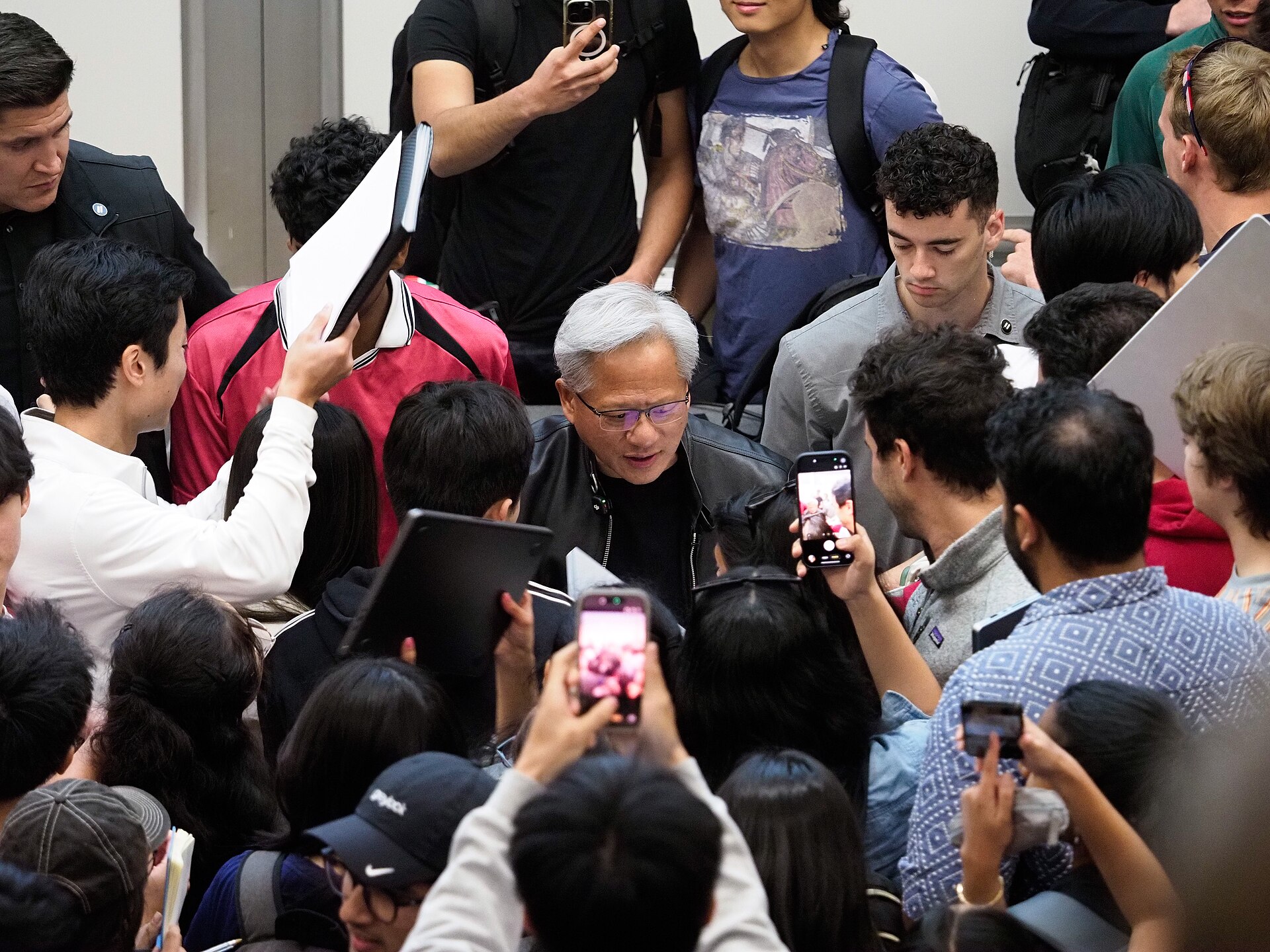
For the best part of three years, the artificial intelligence boom has had a single, unmistakable human face. Jensen Huang, the leather-jacketed co-founder and chief executive of Nvidia, has become the industry’s banker, cheerleader and kingmaker rolled into one, steering not just the world’s most valuable chipmaker but the flow of capital that keeps a sprawling ecosystem of AI start-ups alive. A new analysis from the Australian Financial Review poses an uncomfortable question that most of the sector would rather not dwell on: what happens to all of those companies the day Huang is no longer in the chair?
The AFR’s reporting frames the issue bluntly, warning that the prospect of Huang’s eventual departure, whenever and however it comes, is a story packed with drama that could have an unhappy ending for Firmus and the other companies Nvidia has chosen to bankroll. It is a thought experiment with very real financial stakes, because so much of the current AI build-out rests on a web of relationships, investments and supply guarantees that run back to one person’s judgment about who deserves backing and who does not.
The man who became the market
To understand why a single executive’s future matters so much, it helps to remember how unusual Nvidia’s position has become. The company does not simply sell graphics processing units to whoever can pay. It allocates them. In a world where the chips needed to train frontier AI models are scarce and fiercely contested, a place near the front of Nvidia’s queue has become one of the most valuable assets a start-up can hold. Huang has used that leverage to pick winners, taking equity stakes, signing supply agreements and lending his considerable credibility to companies he believes in.
Jensen Huang has run Nvidia since co-founding it in 1993, an extraordinary tenure by the standards of modern technology companies. That longevity has bred a kind of trust among investors and partners that is almost impossible to transfer. When he speaks at a keynote about the coming wave of agentic AI or sovereign compute, markets move. The flip side of that influence is concentration risk. The more the sector leans on his instincts and his patronage, the larger the hole he would leave behind.
Where Firmus fits in
Firmus is one of the clearest examples of what that patronage can do. The company, which has deep Australian roots and operates the Sustainable Metal Cloud platform using immersion-cooling technology to run dense racks of Nvidia hardware, has positioned itself as a builder of efficient, lower-emission AI data centres across the Asia-Pacific. Its pitch depends heavily on privileged access to Nvidia’s latest silicon and on the validation that comes from being part of the chipmaker’s orbit. Strip away that relationship, or hand it to a successor with different priorities, and the commercial logic becomes far more fragile.
That is the quiet anxiety running beneath the AFR’s piece. Firmus and its peers have raised money, signed customers and promised capacity on the assumption that the supply of chips and goodwill keeps flowing. Those assumptions are reasonable while Huang is in charge. They are much harder to underwrite against an unknown future leadership that may rationalise Nvidia’s web of investments, favour hyperscalers over specialist infrastructure players, or simply lack the appetite to keep propping up a long tail of dependent companies.
Two ways to read the risk
There are, broadly, two schools of thought here. The optimists argue that Nvidia is no longer a one-man band. It has a deep bench, an entrenched software moat in its CUDA ecosystem and a product roadmap that will outlast any single executive. On this view, the company’s relationships with firms such as Firmus are commercially rational rather than personal favours, and would survive a leadership transition largely intact. Demand for AI compute is so overwhelming that whoever holds the keys will keep selling chips to credible builders.
The sceptics counter that the AI trade has been priced for perfection, and that perfection has a face. Much of the sector’s valuation rests on confidence, momentum and the sense that the smartest operator in the room is personally steering the ship. Remove that, and you remove a layer of psychological support that no balance sheet can replace. If sentiment turns, the companies most exposed are precisely the capital-hungry infrastructure players that need continuous funding and cannot easily switch suppliers. A wobble at the top of Nvidia could ripple straight down to them.
Why this matters in Australia
For Australian readers, this is not an abstract Silicon Valley parlour game. Firmus is woven into the local conversation about sovereign AI capability, data centre investment and the push to build compute capacity on home soil rather than renting it from offshore hyperscalers. Governments and super funds have been weighing how much to commit to this kind of infrastructure, and the business cases often lean on exactly the sort of Nvidia partnerships that the AFR is scrutinising. If those partnerships are more contingent than they appear, so are some of the assumptions behind Australia’s domestic AI ambitions.
The timing sharpens the point. The local market has already shown nerves about stretched AI valuations, with the ASX trading cautiously around questions about whether the boom is overbuilt. A reminder that so much of the ecosystem hangs on one executive feeds directly into that unease. For Australian investors holding exposure through technology funds, data centre operators and energy deals tied to AI demand, concentration risk at the very top of the supply chain is a factor worth pricing in, not waving away.
There is also a sovereignty dimension. Canberra has spent the past year talking up the need for home-grown AI models and infrastructure that is not wholly dependent on a handful of foreign gatekeepers. The Huang question is a vivid illustration of why that debate matters. A compute strategy that relies on the continued goodwill of a single overseas chief executive is, by definition, not sovereign.
What happens next
None of this suggests Huang is going anywhere soon, and Nvidia has given no indication of a transition. The value in the AFR’s analysis is that it forces the sector to confront a dependency it has been happy to ignore while the share price climbs. For Firmus, the sensible response is to keep diversifying its relationships, proving the standalone merit of its efficiency technology and reducing the share of its story that rests on one patron. For investors and policymakers, the lesson is to stress-test the AI build-out against a scenario where the current leadership map is redrawn. The boom may well continue regardless. But a market this concentrated around one person is carrying a risk that is easy to name and hard to hedge, and pretending otherwise does nobody any favours.
Sources: Australian Financial Review (Technology).



Comments 3