



















































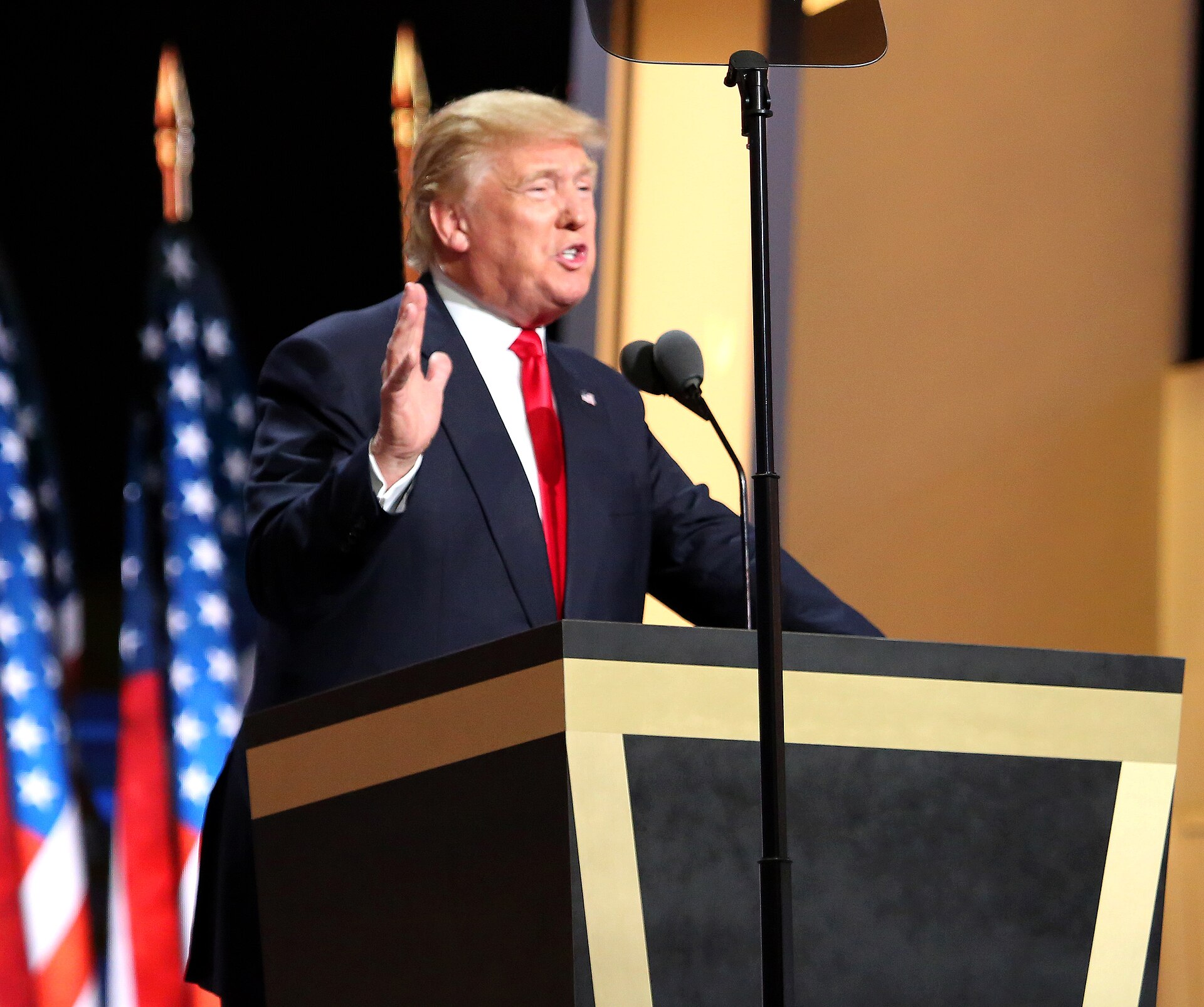
Donald Trump has put the world’s largest artificial intelligence companies on notice, warning that firms choosing to build their computing muscle outside the United States could find themselves penalised by Washington. The message, delivered in his characteristically blunt style, lands at an awkward moment for allies like Australia that have spent the past two years courting exactly the kind of investment the president now wants kept at home.
According to The Australian, the president’s warning is aimed squarely at the handful of companies that dominate the AI build-out, the chip designers, cloud providers and model makers whose spending now runs into the hundreds of billions of dollars. The implied threat is that anything resembling favourable treatment, whether that is export approvals, federal contracts or regulatory goodwill, could be withheld from businesses that send their flagship facilities abroad.
The context behind the threat
Trump’s comments fit a pattern that has defined his second term. Since returning to office he has leant heavily on the argument that the AI race is a contest the United States must win outright, and that American capital, American chips and American electricity should power American data centres first. The administration has already moved to loosen environmental approvals for power-hungry computing campuses at home while tightening the rules on where the most advanced semiconductors can be shipped.
The economics explain why he is willing to make such a public demand. A single hyperscale AI campus can represent a commitment of tens of billions of dollars, thousands of construction jobs and a long tail of ongoing employment in operations, maintenance and energy supply. For a president who measures success in domestic investment announcements, watching that money flow to the Gulf states, South-East Asia or even friendly partners like Australia is politically unpalatable.
Yet the companies themselves have perfectly rational reasons to look offshore. Access to cheap and reliable power is the single biggest constraint on AI expansion, and parts of the United States are already straining to supply enough electricity. Proximity to customers, data sovereignty laws that require information to stay within a country’s borders, and the sheer difficulty of securing grid connections at home all push the giants to spread their infrastructure across multiple jurisdictions.
Two ways to read it
One view, popular among Trump’s supporters, is that the threat is a legitimate use of leverage. If American taxpayers are subsidising the research, the chips and in some cases the energy that makes these companies possible, the argument runs, then those firms owe something back in the form of domestic jobs and strategic capability. On this reading the warning is less about punishment than about aligning private incentives with national interest.
The opposing view is that coercing companies into keeping infrastructure at home risks backfiring. Industry analysts have long argued that a resilient AI network needs to be distributed, both for latency reasons and to guard against the catastrophic failure of any single region. Forcing concentration inside American borders could make the system more fragile, not less, and may simply hand an opening to Chinese providers eager to fill the gap in markets the Americans vacate. Critics also note that the United States does not, in practice, have a straightforward legal mechanism to stop a private company from building a data centre in another sovereign nation.
What it means for Australia
This is where the story turns distinctly local. Australia has positioned itself as a natural home for the AI build-out, pointing to political stability, abundant land, a strong rule of law and the tantalising prospect of pairing data centres with renewable energy and, eventually, nuclear-adjacent baseload options under discussion in parts of the country. State governments in New South Wales, Victoria and Queensland have actively wooed hyperscale operators, and the recent controversy over the Western Downs digital park in Queensland shows just how real these projects have become on the ground.
If Washington genuinely begins leaning on the likes of Nvidia, Microsoft, Amazon and Google to repatriate their most important facilities, the pipeline of investment Australia has been counting on could thin out. That matters because much of the economic case for Australian AI infrastructure rests on attracting foreign capital rather than generating it domestically. A chilling effect from the Oval Office would be felt in the regional towns pitching themselves as future data hubs and in the energy projects being planned around them.
There is a more hopeful reading for Australia as well. The president’s hostility is directed at building offshore in general, but his administration has drawn a sharp distinction between adversaries and allies when it comes to technology. Australia sits firmly inside the trusted circle, reinforced by AUKUS and by the recent Quad commitments on AI cooperation. It is plausible that facilities built on allied soil, under agreements that keep the most sensitive workloads within a Western security umbrella, could be treated as an extension of American capability rather than a leak from it. The question is whether that nuance survives contact with a president who prefers simple messages.
For Australian policymakers, the practical lesson is that the terms of the global AI build-out are being set in Washington, and that any national strategy to attract computing investment has to be stress-tested against American politics. The skills shortage that already acts as a handbrake on local AI growth is one domestic problem; the risk that the investment itself gets called home is an external one that Canberra cannot control.
What happens next
Much will depend on whether the threat hardens into policy. So far it reads as pressure rather than law, and the companies involved have strong commercial reasons to keep expanding internationally regardless of political mood in the United States. Watch for how the administration dresses up any formal measures, whether through export controls, procurement rules or tax incentives that reward domestic construction. Watch too for how Australian trade and industry officials respond, because a clear statement that allied infrastructure is welcome could turn a headwind into an opportunity. For now, the message from the White House is unmistakable, even if the mechanism to enforce it is not.
Sources: The Australian.


