














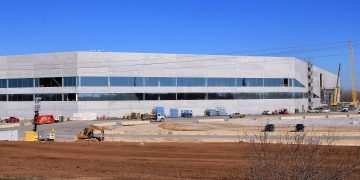















Anthropic is in advanced talks to buy up to 1.4 gigawatts of data-centre capacity across Australia, a build valued as high as A$150 billion and equal to almost the entire national fleet as it stood at the end of 2025. If the plan lands, one American AI company would roughly double the country’s compute footprint in a single move.
The scale is the headline. Australia finished 2025 with about 1.4GW of operational data-centre capacity spread across roughly 162 facilities, according to modelling cited by the Australian Energy Market Operator. Anthropic wants to match that on its own, and it wants at least 1GW of it running by the end of 2027.
What is on the table
The reporting, first surfaced by the Australian Financial Review and picked up by The Silicon Review, describes a tender that went to Australia’s largest operators. Requests for proposal reached CDC Data Centres, AirTrunk, NextDC, IREN and Stack Infrastructure, per data-centre trade outlet w.media. First-round proposals landed in March 2026, and shortlisted bidders have since attended site meetings in Canberra.
Anthropic looks likely to spread the work rather than hand it to one operator. The company may split capacity across four or five providers, with CDC Data Centres reportedly in line for the largest slice at about 500MW. That would suit a market where no single Australian operator has spare gigawatt-scale capacity sitting idle.
The money is large but worth reading carefully. The A$150 billion figure is a headline project value across the full life of the build. The financing Anthropic is understood to be arranging sits at roughly US$12 to US$15 billion in debt and equity, w.media reports. Notably, tender documents acknowledge Anthropic is rated non-investment-grade by credit agencies, a reminder that even the best-capitalised AI labs are still funding infrastructure on borrowed money against uncertain revenue.
Why Australia, and why now
The pull factors are as much about the United States as Australia. American data-centre expansion has run into power shortages and rising community opposition, pushing hyperscale demand offshore. Australia offers grid connections, land, political stability and, increasingly, renewable supply that AI buyers can point to.
There is a demand-side story too. Anthropic has told outlets it is responding to consistent requests from Australian enterprises and government agencies, particularly those with data-residency requirements that rule out sending workloads offshore. The company opened a Sydney office, has been hiring across compute and data-centre operations locally, and in April 2026 signed a memorandum of understanding with the Australian Government under the National AI Plan. Anthropic chief executive Dario Amodei met Treasurer Jim Chalmers in Canberra around the same time, per The Silicon Review.
That government alignment is not incidental. The MoU commits Anthropic to engage on infrastructure planning and to support expanded energy supply and renewable transmission, the terms most likely to decide whether 1.4GW is deliverable at all.
The grid is the real constraint
Power, not capital, is the binding limit. Belinda Dennett, quoted by The Silicon Review, said viability hinges on firmed energy supply, the speed of grid connections and planning approvals. All three are pressure points in Australia right now.
Analysis from the Clean Energy Finance Corporation and Baringa warns that unchecked data-centre growth could lift New South Wales wholesale power prices by 26 per cent and Victorian prices by 23 per cent by 2035, and raise emissions across the National Electricity Market by 14 per cent, unless matched by new renewables and storage. A single 1.4GW load would land squarely inside those projections. For context, the entire sector used around 2 per cent of main-grid electricity in 2024-25.
The counter-case is that a buyer of Anthropic’s scale can bankroll the firmed renewable supply that smaller loads cannot, effectively funding new generation as part of the deal. The MoU language about energy transition suggests both sides know this is the price of entry.
Why it matters for Australia
This is the largest AI-infrastructure bet ever contemplated on Australian soil, and its effects reach well past the operators named in the tender. Doubling national compute capacity would reshape grid planning, put fresh strain on already contested connection queues, and force energy policy to reckon with a single customer larger than most industrial loads in the country.
Every major local operator stands to gain. A 500MW anchor tenancy would be transformative for CDC, and even the smaller shares on offer represent years of committed demand for AirTrunk, NextDC, IREN and Stack. For a listed player like NextDC, and for IREN, whose shares have moved on the speculation, the contracts carry real market weight. The flipside is concentration risk: hitching a large chunk of the national fleet to one non-investment-grade customer chasing a fast-moving AI market.
It also lands as a governance test. Canberra has courted AI investment through the National AI Plan, but a load this size sharpens every unresolved question about who pays for the grid upgrades, how communities are consulted, and whether new demand is genuinely matched by new clean supply rather than crowding out households.
Final decisions are expected within weeks. Whatever Anthropic signs, the tender has already redrawn the ambition of Australia’s compute sector, and turned the grid into the deciding vote.
Sources: The Silicon Review, w.media, Clean Energy Finance Corporation / Baringa, Australian Energy Market Operator.