



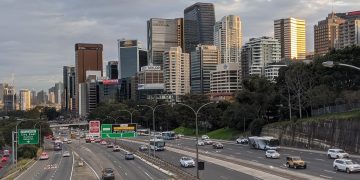




































Canberra has long been a town where the economy moves to the rhythm of the public service, big infrastructure builds and a steady flow of newcomers. On Wednesday, the ACT’s Chief Minister signalled that the formula powering the capital’s prosperity needs to change, and that artificial intelligence and homegrown technology firms will have to shoulder far more of the load in the years ahead.
Delivering his State of the Territory speech to a Canberra Business Chamber event, Andrew Barr argued that the adoption of AI and the continued expansion of technology-based industries would become the main engines of productivity and private sector growth as two familiar drivers, population growth through migration and a pipeline of public construction, begin to taper off. The message, reported by The Riotact Canberra, was essentially that the Territory cannot keep leaning on the levers that have carried it through the past decade.
Why the old settings are running out of road
For years the ACT has posted some of the strongest economic numbers in the country, buoyed by a swelling population and an almost continuous program of government-backed building, from light rail to new suburbs, hospitals and schools. That combination has kept unemployment low and household spending healthy. But both forces are now easing. National migration settings are being wound back as the Commonwealth responds to housing pressure, and many of the Territory’s marquee infrastructure projects are either finishing or moving into quieter phases.
When those tailwinds fade, the question becomes what fills the gap. Barr’s answer is productivity, and his bet is that AI is the most plausible route to lifting output per worker in an economy where so much of the workforce sits in knowledge-heavy roles, whether in the public sector, professional services, defence-adjacent industries or research. In a city thick with analysts, policy writers, lawyers and software developers, the argument that AI tools can make each worker meaningfully more productive is an easier one to make than in, say, a mining or agricultural region.
The Chief Minister also used the address to back a trade agreement between Australia and the European Union, positioning closer EU ties as a way to open export markets for Canberra businesses and diversify an economy that is unusually dependent on a single employer, the federal government. For a capital that exports relatively little in the traditional sense, the logic is that services, research collaboration and technology products could find receptive buyers across Europe if the trade settings are right.
A city already building an AI base
Barr’s pitch does not land in a vacuum. Canberra has quietly assembled some of the ingredients that a technology economy needs. The Australian National University and the University of Canberra feed a steady supply of graduates, and the city hosts a dense cluster of data, cyber security and space-adjacent firms that have grown up around federal procurement. Sovereign capability, the idea that sensitive work should be done by Australian-owned and Australian-based providers, has become a selling point for local operators chasing government contracts.
That same proximity to government, however, cuts both ways. A large share of Canberra’s private technology sector exists to serve the Commonwealth, which means its fortunes are tied to public spending decisions made a few kilometres away. If the Territory wants genuinely independent growth, its tech firms will need customers well beyond the departments lining Barton and Parkes, which is precisely why the EU trade angle matters to Barr’s broader story.
Two ways to read the strategy
Supporters of the approach will say Barr is simply being honest about where the economy is heading. Treasuries around the country are counting on an AI-driven productivity bounce to lift living standards, and a public-service town is arguably better placed than most to capture those gains because so much of its work is digital and text-based to begin with. Betting on AI and on new export markets is, on this reading, a sensible hedge against the slow fade of migration and construction.
Sceptics will raise two objections. The first is that productivity promises attached to AI remain largely unproven at the scale governments are banking on, and that the technology has so far delivered more in pilots and demonstrations than in measurable, economy-wide output. The second is closer to home: an AI-led efficiency drive inside the public service could just as easily translate into fewer roles as into more valuable ones. In a city where the Commonwealth is the dominant employer, any serious push to automate administrative and analytical work carries obvious implications for jobs, and residents will want to know whether efficiency means growth or simply a smaller payroll.
There is also the hard question of enablers. AI at scale needs data centres, and data centres need power, water and land, all of which are becoming contested across the eastern states. Canberra will be competing for the same energy and infrastructure that every other jurisdiction now wants for its own AI ambitions.
What it means for Australia
Canberra is a useful test case for the rest of the country. If a services-heavy, government-anchored economy can convert AI adoption into real productivity gains, it offers a template for other knowledge-intensive parts of Australia, from the professional hubs of Sydney and Melbourne to the research corridors scattered across the states. If it cannot, that will temper some of the national optimism that AI alone can lift living standards.
The policy choices Barr makes will also ripple outward because the ACT often moves early on regulation and procurement. How the Territory handles AI in its own agencies, including transparency, human oversight and the treatment of affected workers, will be watched by other governments weighing similar moves. Canberra has already been grappling with rules on algorithmic decision-making in public administration, and those debates will only sharpen as AI is pushed deeper into the workings of government.
What’s next
The real test will come in the ACT Budget and in the detail of any industry support that follows the speech. A State of the Territory address sets direction; it does not, on its own, build an AI economy. Business groups will be looking for concrete commitments on skills, on attracting private technology investment and on the energy and digital infrastructure that AI depends upon. On the trade front, much hinges on whether Australia and the EU can finally land an agreement after years of stop-start negotiation, something well beyond the Chief Minister’s control.
For now, Barr has made his wager clear. The capital’s next growth phase, in his telling, will be written less in concrete and migration numbers and more in code, data and the productivity those tools can unlock. Whether Canberra’s economy delivers on that promise is the story worth watching.
Sources: The Riotact Canberra.