





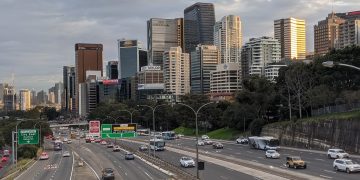
































Every few weeks a fresh voice steps forward to declare that artificial intelligence will remake the Australian economy, and this week it was the turn of a Sky News commentator. In a segment that has been circulating widely on social media, the network’s host Jaimee Rogers argued that AI could become one of the “biggest economic opportunities” the country has ever seen. It is a big claim, and one worth taking seriously rather than dismissing as cable-news hype, because the underlying question of what AI is actually worth to Australia has become one of the defining economic debates of the decade.
The pitch
The case Rogers put forward will be familiar to anyone who has followed the productivity conversation over the past two years. Australia has spent the better part of a decade wrestling with sluggish productivity growth, a problem that Treasury and the Reserve Bank have both flagged as the single biggest drag on future living standards. The optimistic view holds that AI, by automating routine cognitive work and lifting the output of everyone from radiologists to conveyancers, offers a way out of that slump without the political pain of tax reform or industrial relations overhauls. If a knowledge worker can do in an afternoon what used to take a week, so the argument goes, the whole economy grows richer.
There is real money behind that thesis. The Tech Council of Australia has estimated that generative AI could add between $45 billion and $115 billion a year to the economy by 2030, a range wide enough to reflect genuine uncertainty but large enough at either end to command attention. Consulting firms have produced their own figures, most of them in the hundreds of billions over the coming decade. When commentators talk about AI as a generational opportunity, these are the numbers doing the heavy lifting.
Why the optimism is not universal
The trouble with headline figures is that they describe a ceiling, not a floor, and getting anywhere near that ceiling depends on a long list of things going right. Productivity gains from new technology have a habit of taking far longer to materialise than the initial excitement suggests, a pattern economists have watched play out with electricity, computers and the internet. The historian and Nobel laureate has a name for it, the productivity paradox, and it describes exactly the gap between how transformative a technology feels and how little it shows up in the national accounts for years afterward.
Australia also carries some specific handicaps. The country is a heavy adopter of overseas technology rather than a builder of it, which means much of the value created by AI models developed in California or Beijing flows offshore in licensing fees and cloud bills rather than staying onshore as wages and profits. Skills shortages remain acute, with universities and employers both warning that the workforce is not being retrained fast enough to capture the gains on offer. And the energy demands of the data centres that AI runs on are colliding with a grid already under strain, a tension that has played out publicly in debates over projects in regional New South Wales and the Northern Territory.
Then there is the jobs question, which the optimistic framing tends to skate over. The same technology that promises to lift productivity does so, in part, by reducing the amount of human labour needed for a given task. Australian employers have already begun citing AI in restructuring decisions, and the political class has taken notice. Federal Labor figures have repeatedly cautioned against what they see as overheated promises from the technology sector, and the message that not everything the “tech bros” say is true has become something of a refrain in Canberra.
What it means for Australia
Strip away the rhetoric and the honest position is that AI represents an opportunity whose size is entirely conditional on policy and execution. The Productivity Commission has made clear that the technology could deliver a meaningful uplift, but only if the country invests in skills, gets its energy settings right and avoids the twin traps of either smothering innovation with premature regulation or waving it through with no guardrails at all. That is a harder message to deliver in a two-minute television segment than “biggest economic opportunity”, but it is closer to what the evidence supports.
For Australian businesses, the practical takeaway is that the gains are real but not automatic. The firms capturing value from AI are, for the most part, the ones that have done the unglamorous work of cleaning up their data, retraining staff and redesigning processes around the technology rather than simply bolting a chatbot onto existing operations. The banks have been among the more disciplined adopters, and their experience suggests that the return on AI is proportional to the effort invested, not the enthusiasm expressed. For small and medium enterprises, which make up the overwhelming majority of Australian employers, the barriers of cost and expertise remain stubbornly high, which is why government-backed advisory schemes have started to appear.
What’s next
The debate that Rogers waded into is not going to be settled by any single commentator, and it will play out over years rather than news cycles. The more useful frame is to treat bold claims about AI’s economic potential as hypotheses to be tested against the productivity data as it arrives, quarter by quarter, rather than as settled fact. If the optimists are right, the evidence will show up in rising output per hour worked and in businesses that grow without proportionally growing their headcount. If the sceptics are right, the gap between promise and delivery will persist, and the hundred-billion-dollar figures will look, in hindsight, like the dot-com projections of an earlier era.
What is beyond dispute is that Australia has a genuine choice to make about how aggressively to lean into the technology, and how much to invest in the skills, infrastructure and governance needed to capture the upside rather than merely importing the disruption. On that much, at least, the optimists and the sceptics can agree. The opportunity is real. Whether Australia seizes it is a question of policy and effort, not of enthusiasm.
Sources: Sky News Australia.