

















































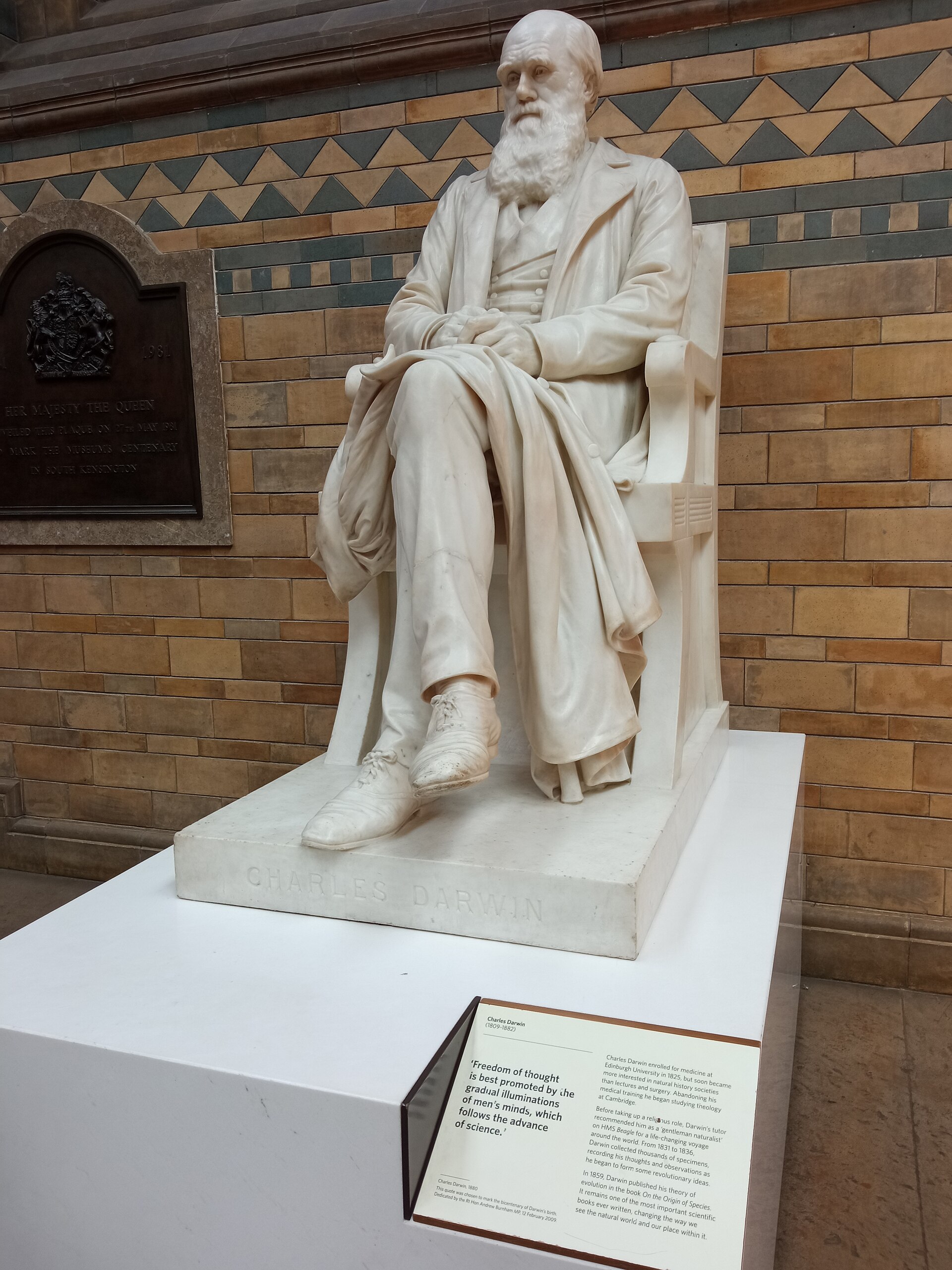
Every biology student learns the story as a knockout blow. In one corner stands Charles Darwin, whose theory of natural selection explained how species change through random variation and survival of the fittest. In the other stands Jean-Baptiste Lamarck, the French naturalist usually wheeled out as the cautionary tale, the man who supposedly believed a giraffe could stretch its neck reaching for high leaves and then pass that longer neck to its offspring. For most of the twentieth century, Lamarck was the loser of that contest, a historical footnote used to make Darwin look sharper by comparison.
That tidy verdict is being challenged again. In a piece headlined “Culture change: Darwin’s rival Lamarck is back”, the American science and ideas outlet Mind Matters argues that the caricature has outlived its usefulness, and that some of what Lamarck was reaching for has quietly returned to respectable science. It is a philosophy-of-science story on its face. For anyone building or thinking about artificial intelligence, though, it lands much closer to home, because the very mechanism Lamarck described is already baked into how some machines learn.
Why the old loser is getting a second look
The rehabilitation of Lamarck did not come from nostalgia. It came from the data. Over the past two decades the field of epigenetics has shown that the environment an organism experiences can switch genes on and off, and that some of those changes can be handed down to the next generation without altering the underlying DNA sequence. Stress, diet and exposure to toxins have all been linked to inherited effects in animal studies. None of this proves that giraffes lengthen their necks by wishing it, but it does mean the flat claim that acquired characteristics can never be inherited is no longer as flat as the textbooks suggested.
There is a second thread, and it is the one the headline points at. Culture is a form of inheritance that plainly does pass acquired traits along. A skill, a habit or a story learned in one lifetime can be taught to the next generation and refined again, with no genetics involved at all. Human beings are the obvious example, but the same logic applies wherever information is copied, learned and passed on. That is a Lamarckian pattern in everything but name, and it is why the debate keeps refusing to die.
The distinction lives inside AI
Here is where the argument stops being a museum curiosity for anyone in the technology sector. In the field of evolutionary computation, which uses the logic of natural selection to breed better solutions to hard problems, “Lamarckian” and “Darwinian” are not insults thrown across a common room. They are precise engineering choices with real names.
In a Darwinian setup, a population of candidate solutions competes, the strongest reproduce, and any learning an individual does during its lifetime is thrown away when it dies. In a Lamarckian setup, the improvements a candidate makes while it is running are written straight back into its genetic code and inherited directly by the next generation. Researchers have built and compared both for decades, along with a middle path known as the Baldwin effect, where learning shapes selection without being copied into the genome. The choice is not academic. Lamarckian schemes often converge on an answer far faster, at the risk of rushing toward a shortcut that turns out to be a dead end. This is the same trade-off engineers wrestle with today when they decide how much of what a model learns should be folded permanently back into its weights.
Pull the lens back further and the resemblance grows. A large language model is, in a loose but useful sense, a Lamarckian engine for culture. It ingests the accumulated writing of a civilisation, absorbs patterns that no single human deliberately designed, and passes a remixed version of them to millions of users who feed the results back into the pool. Acquired information is inherited, altered and inherited again, at a speed no biological system could match. The Mind Matters framing, that culture is where Lamarck was always right, is an oddly good description of what generative AI actually does to human knowledge.
Two ways to read the revival
Not everyone welcomes the comeback, and the disagreement is worth spelling out. Mainstream evolutionary biologists tend to argue that the “Lamarck was right all along” framing is overcooked. Epigenetic inheritance, they point out, is usually short-lived and rarely survives more than a few generations, and cultural transmission is simply a different system that Darwin’s framework was never meant to cover. On this view, dressing modern findings in Lamarck’s coat confuses the public more than it enlightens them.
The other camp, which the article leans toward, counters that the textbook story was always more ideology than evidence, and that the reflex to rubbish Lamarck has slowed honest inquiry into how inheritance really works. For the AI community, the value of the debate is not in crowning a winner. It is in the reminder that “evolution” is not one fixed mechanism but a family of them, and that the choices designers make about which mechanism to copy have consequences for how fast, how safely and how predictably a system improves.
What it means for Australia
Australia has more skin in this than the abstract framing suggests. Evolutionary computation has a long and genuine history in Australian research, from optimisation work at CSIRO through to neuroevolution and genetic-algorithm groups at universities including UNSW, Monash and RMIT. As the national conversation shifts toward home-grown models and sovereign AI capability, the question of how systems ought to learn and pass on what they learn is not a philosophical luxury. It sits underneath practical decisions about training, fine-tuning and the safety guardrails that keep a self-improving system from optimising its way into trouble.
There is a policy dimension too. Australian regulators and the researchers advising them are grappling with how to govern technology that changes after it is deployed. A Lamarckian machine, one that rewrites its own inherited behaviour on the fly, is far harder to certify and audit than a static tool that behaves the same way every time. The Lamarck-versus-Darwin distinction, dusted off, turns out to be a surprisingly clean way of naming that problem for people who will never open a biology textbook.
What’s next
The scientific argument over inheritance will keep grinding on in the journals, because the evidence on epigenetics is still being fought over and neither camp is close to conceding. The more interesting movement will be in how the AI field borrows the vocabulary. As Australian teams push toward sovereign models and as evolutionary methods creep back into mainstream machine learning, expect “Lamarckian” and “Darwinian” to keep showing up as design labels rather than dusty history. Lamarck spent two centuries as the answer to a trick question. He may end up more useful as a way of describing the machines now reshaping how a whole culture learns.
Sources: Mind Matters, “Culture change: Darwin’s rival Lamarck is back”.