



















































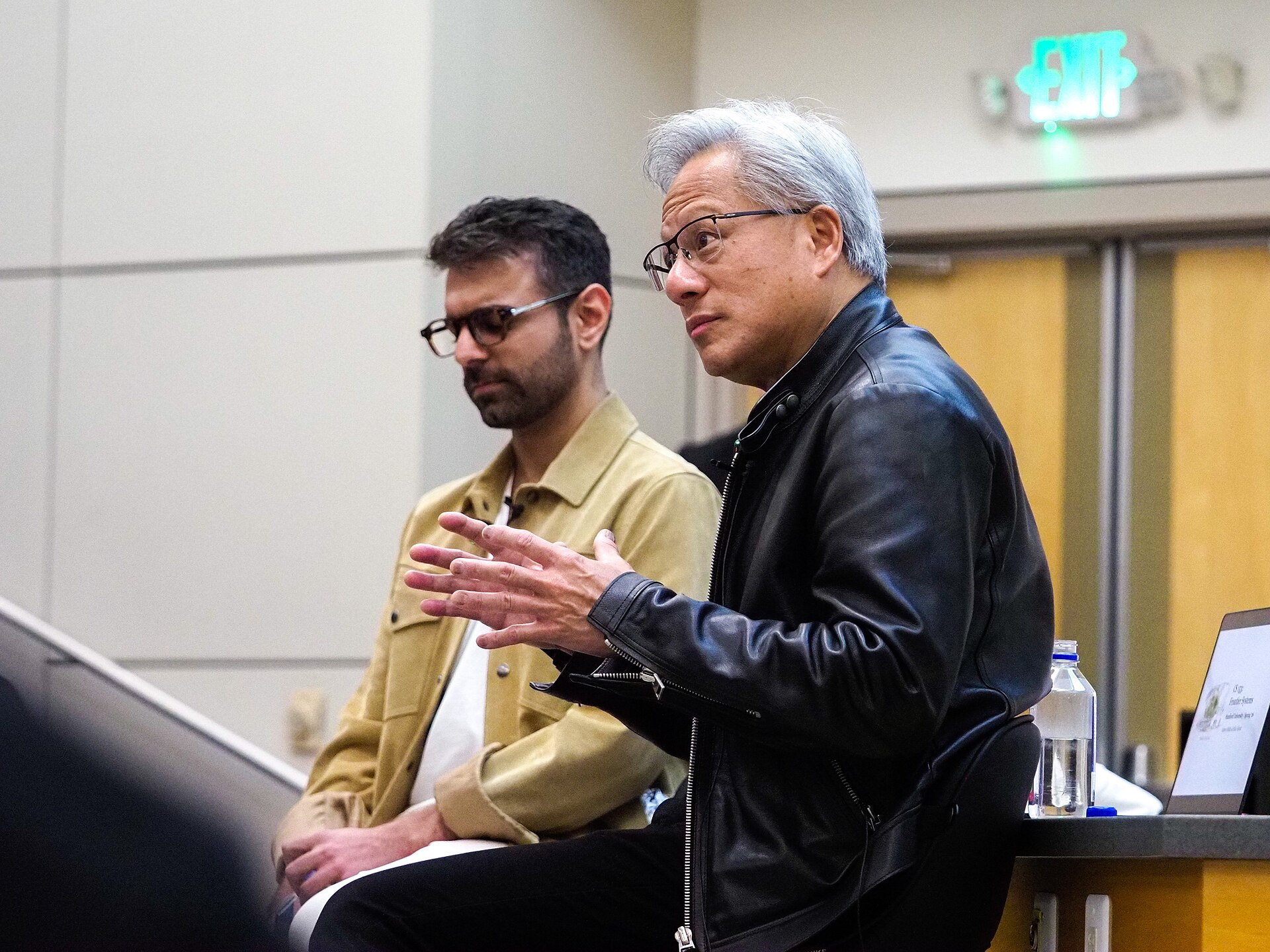
For the better part of three years, the global artificial intelligence story has had a single, unmistakable face. Jensen Huang, the leather-jacketed founder of Nvidia, has become the figure investors associate with the whole boom, the chief salesman for a future in which every company runs on graphics chips and vast data centres. Now a new worry is circulating through trading desks and fund managers’ notes, and it has little to do with chip supply or export controls. It is the fear of what happens to the money when Huang is no longer there.
That is the uncomfortable question explored in The Australian, which reports that investors are increasingly nervous about the so-called key-man risk sitting at the centre of the AI trade. The concern is not that Huang is going anywhere imminently. It is that the entire financing structure of the AI build-out has quietly come to depend on confidence in him personally, and that confidence is harder to insure than any factory or data centre.
How one man became the system
To understand the anxiety, it helps to see how tightly the AI economy has wound itself around Nvidia. The company does not merely sell the chips that train large language models. It has become a financier, a kingmaker and a demand-generator all at once, taking stakes in the very start-ups that then turn around and buy its hardware. Capital flows from Nvidia to AI labs and cloud operators, which spend it on Nvidia processors, which lifts Nvidia’s revenue, which lifts its valuation, which gives it more firepower to invest. It is a circular arrangement that works beautifully while everyone believes the growth is real.
Huang sits at the top of that circle. His quarterly pronouncements move not just Nvidia’s share price but the mood of the whole market, and his insistence that demand for computing power is effectively insatiable has underwritten enormous bets by rivals, customers and investors alike. That is precisely why his eventual departure, whether through retirement, illness or simple succession, looms as a genuine market event rather than a routine corporate transition. The man has become shorthand for the credibility of the trade.
Two ways to read the fear
There are two broad schools of thought on how much this actually matters. The sceptics argue that the worry is overblown and a touch romantic. Nvidia, on this view, is an institution with deep engineering talent, a dominant software ecosystem in CUDA and a product roadmap that stretches years ahead. Great companies outlast their founders all the time, and markets have a habit of mourning charismatic chief executives loudly and then moving on quickly. Apple survived the loss of Steve Jobs and went on to become the most valuable company on earth. By that logic, a well-managed handover would cause a few volatile sessions and little lasting damage.
The other camp is less sanguine, and its argument is subtler. The risk, they say, is not operational but psychological. Because so much of the AI financing boom runs on belief rather than current profits, anything that dents that belief can be self-reinforcing on the way down. If Huang’s exit prompted even a modest reassessment of how durable AI demand really is, it could ripple through the circular financing arrangements, make lenders more cautious, slow the flow of capital into data centres and expose just how many of the sector’s grand spending plans assume the music never stops. In a market priced for perfection, the loss of the person most associated with that perfection is not a small thing.
Both readings share a common premise worth sitting with: an industry this large should not be this dependent on the health and intentions of a single executive. That it is tells you something about how fast the AI boom has run ahead of the normal guardrails of diversified risk.
Why Australia should care
It would be easy to file this under distant American drama, but the exposure runs straight into Australian wallets. Nvidia has become one of the most widely held stocks on the planet, and it sits inside the global equity portfolios of nearly every large Australian superannuation fund, usually through index strategies that automatically weight toward the biggest companies. The strong run in AI names has flattered balance dates and quietly lifted the retirement savings of millions of Australians who have never typed a prompt in their lives. A sharp, confidence-driven repricing of the AI trade would flow through to those same balances.
The local market has already shown how sensitive it is to the mood emanating from Nvidia. Earlier swings in the AI complex have dragged on the ASX, hitting listed technology names and the growing cohort of Australian firms whose valuations lean on the AI growth story. Data centre developers, energy providers eyeing the compute boom and the contractors building the physical infrastructure are all, to varying degrees, betting that the demand Huang keeps describing will keep arriving. If the financing that funds that construction became more expensive or more cautious, some of Australia’s own AI infrastructure ambitions could be caught in the downdraft.
There is a sovereignty dimension too. Canberra and local industry groups have spent much of this year talking up the need for home-grown AI capability, sovereign compute and local chips. A boom underwritten by a single foreign supplier, and increasingly by confidence in a single foreign chief executive, is a reminder of just how concentrated the plumbing of modern technology has become. For policymakers weighing where to direct investment and attention, the key-man question is really a concentration question, and concentration is exactly what sovereign-capability advocates have been warning about.
What happens next
In the near term, nothing dramatic is likely to change. Huang remains firmly in charge, Nvidia continues to report extraordinary numbers, and the AI build-out shows no sign of slowing. The more probable outcome is that boards, analysts and fund managers begin to treat succession at Nvidia as a serious governance issue rather than a taboo, asking harder questions about depth of leadership, the resilience of the financing web and how much of the valuation is genuinely durable.
For Australian investors, the sensible response is less about reacting to a departure that has not happened and more about understanding how much of their exposure rides on one company and, by extension, one person. The lesson of the moment is not that the AI boom is about to collapse. It is that a story this big should not have a single point of failure, and that the market is finally starting to notice it does.
Sources: The Australian.


