















































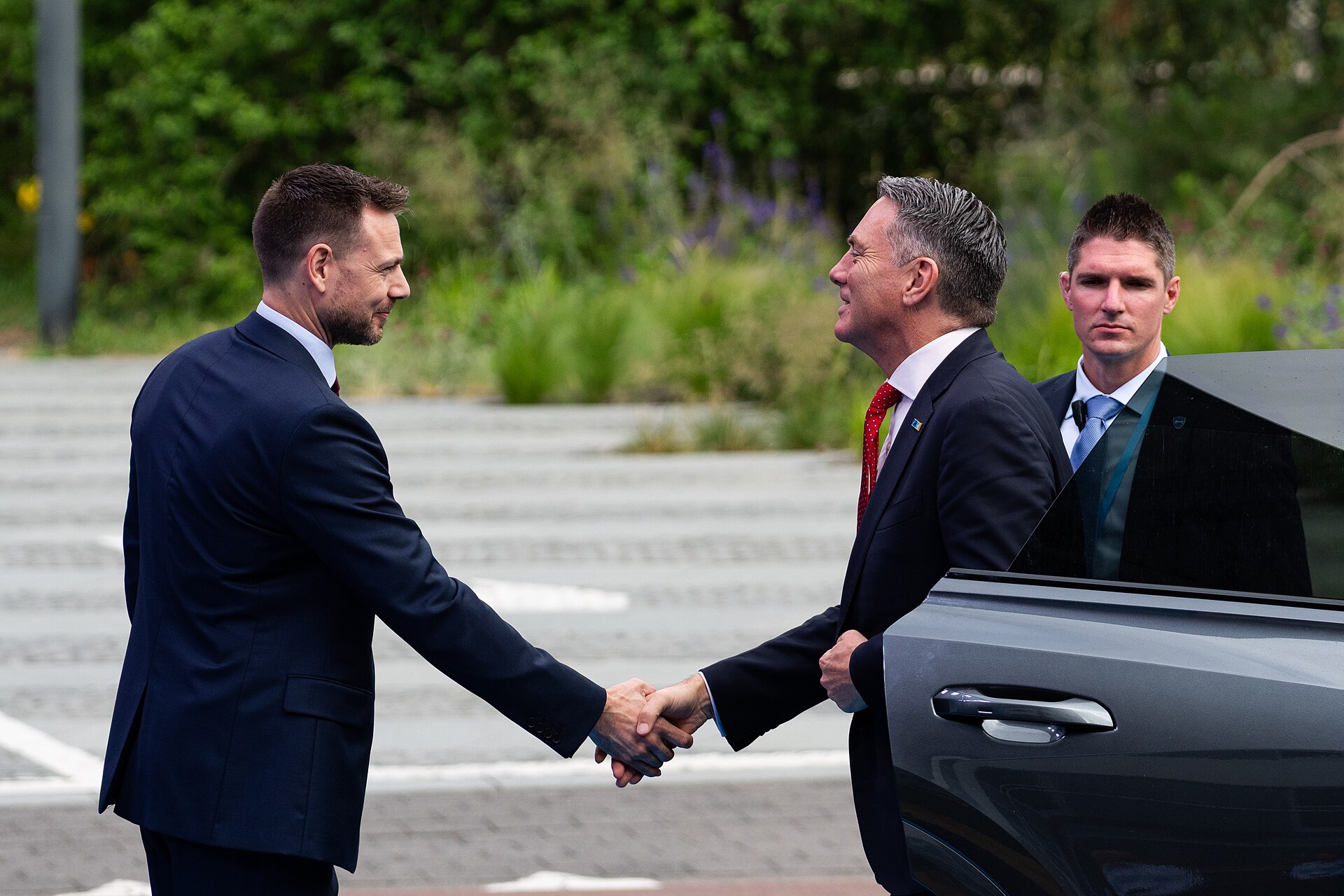
When a senior minister starts talking publicly about the need for a “backup” to artificial intelligence, it is worth paying attention to what is really being said. Deputy Prime Minister and Defence Minister Richard Marles has done exactly that, framing AI not simply as a productivity tool or an economic opportunity but as a piece of critical infrastructure that even the United States cannot afford to leave without a fallback. His comments, reported by Technology Decisions, land awkwardly for an Australian audience, because the obvious follow-up is uncomfortable: if the world’s most powerful AI nation needs a contingency, what does Australia have?
The context behind the comment
Marles sits at the intersection of two of the government’s most sensitive portfolios. As Deputy Prime Minister he carries weight across the full breadth of national policy, and as Defence Minister he is responsible for the systems the country would lean on in a crisis. That combination matters here, because the “backup” he is describing is not a spare laptop in a cupboard. It is the idea that a nation’s reliance on AI, whether for intelligence analysis, logistics, command decisions or basic government services, creates a single point of failure if the underlying models, chips and cloud capacity all sit somewhere beyond your control.
The United States is the clearest case study. It dominates the frontier of model development through companies such as OpenAI, Anthropic and Google, and it dominates the hardware layer through Nvidia. Yet even there, policymakers worry about concentration risk: a handful of firms, a handful of data-centre clusters, and an electricity grid straining to keep up. When Richard Marles suggests America needs a backup, he is pointing at the fragility hiding inside that dominance, and inviting Australians to ask the same question of themselves.
The news, and the gap it exposes
Australia’s position is very different from America’s, and in some ways more exposed. The country does not build frontier models at scale, does not manufacture advanced chips, and runs much of its most important compute on infrastructure operated by foreign hyperscalers. That is not inherently a problem in peacetime. It becomes a problem the moment access is interrupted, whether by a supply shock, an export control, a cyber incident or a shift in the politics of an ally. A backup, in Marles’ framing, is really a question about sovereign control: how much of the AI stack can Australia reach for if the normal channels close.
The government has been circling this issue for some time. The national conversation about AI guardrails, homegrown investment and digital sovereignty has been building through 2025, and a string of parliamentary reports has pushed the idea that Australia needs its own capability rather than a permanent dependence on imported intelligence. Marles’ intervention sharpens that debate by attaching it to national security, which tends to move money and attention faster than economic arguments alone.
Two ways of reading it
There are two broad camps forming around this question, and both have a point. The first argues that Australia should accept its scale and play to its strengths. On this view, trying to replicate American model-building or Taiwanese chip fabrication is a fantasy, and the smarter path is deep integration with trusted partners, backed by sovereign data centres, local talent and the ability to run and fine-tune models on Australian soil. Resilience, in this reading, comes from diversification and from controlling the layers that are actually achievable, such as data, hosting and applications, rather than chasing the parts that are not.
The second camp is more hawkish about dependence. It holds that outsourcing the brains of the nation’s critical systems to overseas providers is a strategic error that will only grow as AI embeds itself in defence, energy and government. Proponents want genuine sovereign compute, domestic model capability and a deliberate plan to keep critical workloads running even if international access is degraded. The disagreement is not really about whether resilience matters. It is about how much of it a middle power can realistically own, and how much it should pay to find out.
What it means for Australia
For Australian businesses, public agencies and investors, the practical stakes are closer than the geopolitics suggests. Every bank, hospital, utility and government department now weaving AI into its operations is making an implicit bet on continuity of supply. If a minister responsible for national defence is openly talking about backups, boards and chief information officers have cover to ask the same question of their own AI strategies: what happens if the model, the API or the cloud region we depend on becomes unavailable, slower, or more expensive overnight.
That has real commercial consequences. It strengthens the case for the local data-centre build-out already under way, for providers offering sovereign and air-gapped hosting, and for the growing push to keep sensitive workloads inside Australian jurisdiction. It also raises hard questions about cost and skills. Sovereign capability is expensive, the pool of specialist engineers is thin, and the energy needed to run serious compute collides with a grid the country is still working to decarbonise. A backup plan that looks reassuring in a speech can look very different on a budget line.
What happens next
The immediate test is whether Marles’ language translates into policy or stays a talking point. Watch for how AI resilience is treated in defence planning, in the next tranche of digital sovereignty funding, and in the government’s response to the parliamentary recommendations on AI governance that have been stacking up. The signals to look for are concrete: investment in sovereign compute, clearer rules for where critical government and defence workloads can be hosted, and incentives for local firms building the hosting, tooling and talent that a credible fallback would require.
The deeper point is that the backup conversation has finally moved from the technology pages to the national security table. Australia has spent much of the past year debating copyright, creative rights and the economic upside of AI. Marles has reframed the discussion around a blunter proposition: resilience is not optional, even the superpower is hedging, and a country that has not answered the backup question for itself is simply hoping it never gets asked at the wrong moment.
Sources: Technology Decisions


