


























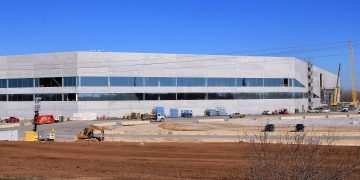























Every conversation about artificial intelligence eventually runs into a very unglamorous reality: the technology has to live somewhere. Behind the chatbots and the copilots sit warehouses full of humming servers, and those buildings need land, power, cooling and, above all, capital. That is the backdrop to the latest move from NextDC (ASX:NXT), the Brisbane-founded data centre operator that has become one of the clearest proxies on the local market for the AI build-out now sweeping the country.
Financial commentary outlet Kalkine Media has framed NextDC’s funding activity as a signal of how aggressively the company intends to scale, describing the move as fuel for Australia’s AI expansion. For a business that has spent more than a decade pouring money into concrete, transformers and fibre, the logic is straightforward. Demand for compute is rising faster than the industry can pour foundations, and the companies that secure land, grid connections and funding early are the ones best placed to capture it.
Why data centres have become a capital story
NextDC has never been a cheap business to run, and that is rather the point. Building hyperscale data centres is enormously capital-intensive work, with individual facilities running into the hundreds of millions of dollars before a single customer plugs in. The company operates a national network of sites across Sydney, Melbourne, Brisbane, Perth and other capitals, and has been steadily expanding its footprint to meet contracted demand from cloud providers and enterprises.
The shift that AI has brought is one of scale and density. Training and running large models requires far more power per rack than the workloads data centres were designed for a few years ago. That changes the economics in two directions at once. It lifts the potential revenue a well-located facility can earn, and it sharply increases the upfront cost of power infrastructure and cooling. In that environment, access to funding is not a back-office detail. It is the competitive moat.
Company founder and long-serving chief executive Craig Scroggie has consistently argued that NextDC is a long-duration infrastructure play rather than a short-term technology bet, and that the current wave of AI demand validates years of building ahead of the curve. Whether investors share that patience is another question, and it is one that sits at the heart of how the market reads any fresh funding move.
Two ways to read the news
The bullish case is easy to state. Australia is short of high-quality, sovereign-capable data centre capacity at exactly the moment when governments, banks and corporates are racing to adopt AI. Every dollar NextDC raises and deploys buys it more of a scarce commodity: shovel-ready capacity in the right postcodes, connected to the grid, with the density modern chips demand. Supporters of the strategy point to the long-term contracts that underpin these facilities, which can lock in revenue for years and give lenders and shareholders confidence that the spending will be repaid.
The more cautious view is not that the demand is fake, but that the cost of chasing it is real and rising. Funding, whether it comes through equity, debt or partnership structures, carries a price. Raising equity can dilute existing shareholders, while leaning on debt adds interest costs and financial risk if demand or pricing softens. Sceptics of the broader data centre boom have warned that a rush to build could outpace the ability of the grid to supply cheap, reliable power, leaving operators exposed to rising energy costs and community pushback. Those concerns are not hypothetical in Australia, where debate over the strain new data centres place on the electricity system has grown louder over the past year.
What it means for Australia
For readers here, the NextDC story is really a story about who owns and controls the infrastructure that will run the country’s AI future. There is a strong national interest argument for having that capacity built and operated locally, under Australian regulation and on Australian soil, rather than depending entirely on offshore providers. Sovereign data capability has become a talking point in Canberra, and companies like NextDC, Macquarie Technology and a wave of newer entrants are positioning themselves as the answer.
The catch is that this build-out lands on top of an energy system already under pressure. Data centres are among the fastest-growing sources of electricity demand in the developed world, and Australia is no exception. The more capital that flows into projects like NextDC’s, the more urgent the questions become about where the power comes from, what it costs, and whether ordinary consumers end up competing with server halls for the same electrons. Governments have been trying to strike a balance between welcoming the investment and jobs these projects bring and managing the grid and planning consequences, a tension that has already surfaced in reporting about the rush to approve new sites before public sentiment turns.
There is also a jobs and skills dimension. Building and running these facilities creates construction work, engineering roles and ongoing operational employment, often in outer-metropolitan and regional areas. That makes the sector attractive to state governments chasing investment, but it also means the benefits and the burdens are unevenly distributed across communities that host the infrastructure.
What happens next
The immediate thing to watch is how the market responds to NextDC’s funding activity, and what the company says about where the money is headed. Investors will be looking for detail on which sites get prioritised, how much new capacity comes online and over what timeframe, and how the spending affects the balance sheet. Analysts will be weighing the growth story against the cost of funding it, and the answer will shape sentiment not just for NextDC but for the broader cohort of ASX-listed infrastructure names riding the AI theme.
Beyond the share price, the bigger question is whether Australia can build the physical backbone of an AI economy quickly enough to matter, without doing it in a way that strains the grid or the public’s patience. NextDC’s willingness to keep raising and spending is a bet that the demand is durable. The next year of results, power deals and planning decisions will tell us whether that bet pays off, and who shares in the reward if it does.
Sources: Kalkine Media.