




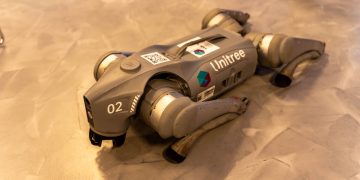














































The humble food delivery, once the preserve of a scooter rider double-parked outside your apartment block, is about to get a robotic understudy on the Gold Coast. DoorDash has begun what it describes as Australia’s first trial of autonomous robot delivery, dispatching knee-high, cooler-sized machines along the city’s footpaths to ferry meals from restaurants to hungry customers. For a country that has watched delivery drones and pavement robots roll out across parts of the United States and Europe for years, it is a notable moment: the technology has finally crossed the Pacific and found an Australian testbed.
According to 7News, diners in the trial zone can now have their orders delivered by a machine weighing as much as 100 kilograms, roughly the heft of a fully grown person, trundling along at a walking pace. The choice of the Gold Coast is not accidental. The city offers wide, relatively flat footpaths, a dense cluster of restaurants and cafes, a warm climate that keeps the machines running year round, and a population that skews towards early adoption of new consumer tech. It is, in many ways, an ideal sandbox for a company wanting to learn how autonomous delivery behaves in Australian conditions before committing to anything larger.
How the trial works
The mechanics will feel familiar to anyone who has used a food delivery app. A customer places an order, a partner restaurant prepares it, and instead of a human courier arriving, a six-wheeled robot rolls up to the kerb. The lid unlocks via the app, the customer lifts out their meal, and the machine heads back for its next job. The robots use a combination of cameras, sensors and mapping software to navigate around pedestrians, cross at designated points and avoid obstacles, with remote human operators able to step in if a machine gets confused or stuck.
DoorDash has been building towards this for some time offshore. In the United States it has run robot and drone deliveries through partnerships with specialist autonomy firms, and it acquired the Finnish sidewalk-robot pioneer Wolt, giving it a European footprint in automated logistics. The Gold Coast pilot is best understood as the Australian beachhead of that global strategy rather than a one-off experiment. The company is testing not just whether the robots can physically do the job, but whether Australian customers, restaurants and councils will embrace them.
Two ways to read it
Supporters of autonomous delivery make a straightforward case. The last mile of any delivery is the most expensive and least efficient part of the journey, and a robot that can run continuously without wages, fuel or fatigue promises to drive those costs down over time. For restaurants squeezed by the commissions that delivery platforms charge, cheaper logistics could eventually mean better margins or lower prices for customers. There is an environmental argument too, since a small electric robot covering a few kilometres uses a fraction of the energy of a petrol scooter or car, and it takes one more vehicle off congested streets.
The sceptics are not hard to find either. Food delivery in Australia is a significant source of flexible income for tens of thousands of gig workers, many of them students and migrants, and automation that works at scale would hollow out that earning opportunity. There are practical worries as well. Australian footpaths are shared with prams, mobility scooters, wheelchairs, dogs and distracted pedestrians, and a 100-kilogram machine moving through that mix raises obvious questions about safety, liability and accessibility. Disability advocates overseas have warned that pavement robots can block kerb ramps and crossings for people who rely on clear paths. Then there is the simple question of theft and vandalism, since a slow-moving box full of hot food is a tempting target.
What it means for Australia
The Gold Coast trial matters well beyond one city’s dinner orders, because it forces a set of regulatory questions that Australia has so far been able to duck. Our footpaths are governed by a patchwork of state road rules and local council by-laws, most of which were written long before anyone imagined an autonomous machine sharing the pavement with pedestrians. Who is liable if a robot clips a toddler or knocks over an elderly resident? What speed limits apply? Do the machines need registration, insurance or a licence? Queensland, and the City of Gold Coast in particular, will effectively be writing the first draft of the answers, and other states will be watching closely.
There is also a bigger-picture angle that fits the national conversation about where Australia sits in the global automation race. Much of the recent debate, from sovereign AI data centres to the country’s thin pipeline of home-grown robotics, has centred on whether we are a maker of this technology or merely a market for it. A trial run by an American platform using robots built offshore lands firmly in the second camp, and that is worth being honest about. The upside is that Australians get to road-test the real thing and shape the rules early. The risk is that the economic value, the intellectual property and the engineering jobs stay overseas while we supply the footpaths and the customers.
For the gig economy, the signal is unmistakable even if the immediate impact is tiny. Platforms have spent a decade arguing that their couriers are independent contractors rather than employees, a fight that has played out in Australia’s courts and before the Fair Work Commission. Automation complicates that story in both directions: it reduces the headcount a platform depends on, but it also undercuts the claim that these are flexible jobs people choose freely when the alternative is being replaced by a machine. The Transport Workers’ Union and others have long pushed for stronger protections for delivery riders, and a visible robot rollout is likely to sharpen those demands.
What’s next
For now, this is a contained pilot rather than a nationwide switch, and its success will be measured in mundane metrics: how many deliveries the robots complete without intervention, how customers rate the experience, how restaurants respond, and whether the machines can cope with a Queensland summer downpour. If the numbers stack up, expect DoorDash to expand the fleet and lobby other councils, and expect rivals to follow quickly rather than cede the ground. If the trial stumbles on safety incidents or public backlash, it could just as easily become a cautionary tale.
Either way, the Gold Coast has quietly become the place where Australia starts answering a question it has been able to avoid until now: what happens when the robots move off the warehouse floor and onto the street where the rest of us walk.
Sources: 7News.


