

















































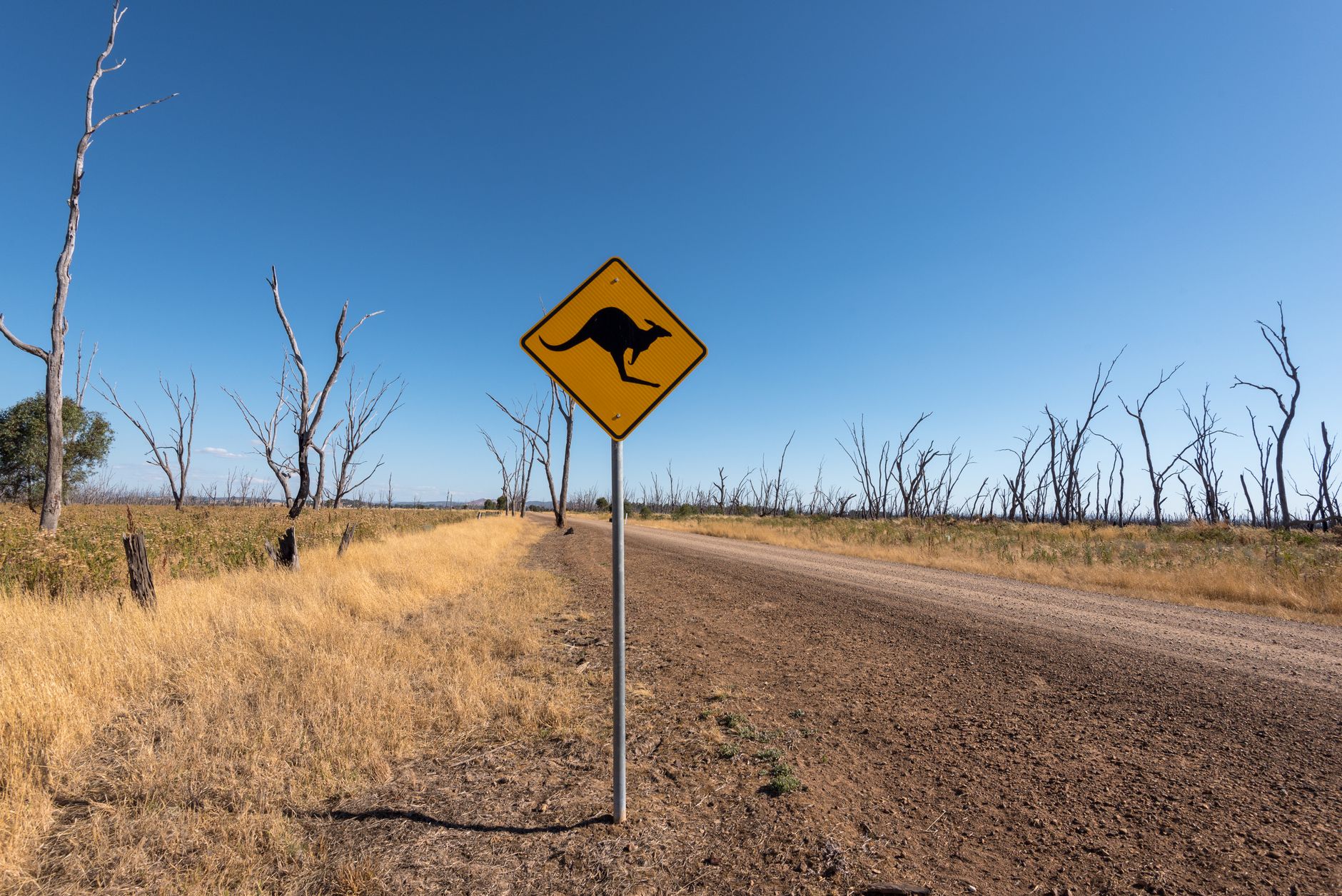
Anyone who has driven a country road at dusk in Australia knows the moment: a shape at the edge of the headlights, a split-second decision, and often no time to make it. Collisions with kangaroos, wombats and deer are so common that they have become a grim feature of rural motoring, and they carry a cost measured in wildlife, damaged vehicles, insurance claims and sometimes human lives. Now a stretch of highway south of Canberra is being used to test whether artificial intelligence can give drivers the seconds of warning they need.
A new trial on the Monaro Highway is pairing AI-assisted cameras with electronic smart signs to detect animals near the roadside and flash a warning to approaching motorists in real time. The idea is simple in principle and complicated in practice: teach a camera system to recognise wildlife as it moves toward the carriageway, then trigger a sign far enough ahead that a driver can ease off the accelerator before the animal ever reaches the bitumen. According to the ABC, the technology is being trialled on the Monaro in the hope of denting a national toll that researchers estimate at around 10 million animals killed on Australian roads every year.
Why the Monaro, and why now
The Monaro Highway is a fitting test bed. It threads through open grazing country and bushland between Canberra and the Snowy Monaro region, carrying commuters, freight and tourists across terrain thick with kangaroos and, increasingly, feral and farmed deer. Long straights and high speed limits leave little margin when an animal bolts, and the road has a reputation among locals for after-dark near misses. That combination of high traffic volumes and abundant wildlife makes it exactly the kind of corridor where a warning system either proves its worth or exposes its limits.
The timing also reflects how far machine vision has come. Static wildlife warning signs, the familiar yellow diamonds with a leaping kangaroo, have been fixtures on Australian roads for decades, but drivers learn to tune them out precisely because they are always on. A sign that only lights up when an animal is actually present carries far more information, and that is the behavioural bet at the heart of the trial. If motorists come to trust that a flashing warning means something is genuinely there, they are more likely to react. The hard part is building a detection system accurate enough to earn that trust without crying wolf.
Two ways to read the technology
Supporters of the approach see it as a practical, relatively low-cost intervention that works with the road network we already have. Fencing an entire highway is expensive and can trap animals on the wrong side or funnel them toward gaps. Wildlife overpasses and underpasses, which have worked well in places such as the Hume corridor and overseas, are effective but slow and costly to build. An AI camera-and-sign system can, in theory, be bolted onto existing infrastructure at known blackspots and moved or tuned as conditions change. For transport agencies weighing tight budgets against a stubborn safety problem, that flexibility is appealing.
Sceptics raise fair questions. Detection systems can struggle in the very conditions when strikes are most likely, at dawn, at dusk and in rain or fog, when visibility is poor and animals are on the move. There is the risk of false positives that dull driver attention over time, and the opposite risk of missed detections that breed false confidence. Ecologists have long argued that technology should complement, not replace, the harder work of managing habitat, culverts and connectivity so animals are not pushed onto roads in the first place. A camera that warns of a kangaroo does nothing to address why the kangaroo is crossing there. The most credible view is that smart signs are one tool in a wider kit, valuable at specific hotspots rather than a highway-wide fix.
The Australian stakes
The scale of the problem gives the trial national weight. Ten million animal deaths a year is a staggering figure, and it understates the full toll because so many collisions go unreported or leave injured animals to die away from the road. Beyond the welfare cost, wildlife strikes are a genuine human safety issue. Swerving to avoid an animal is a common cause of single-vehicle crashes, and larger animals such as deer and cattle can cause serious injury on impact. Insurers field a steady stream of claims from animal collisions, particularly through winter when shorter days push more driving into low-light hours.
There is an economic and conservation dimension too. Australia’s roadkill burden falls heavily on threatened species in some regions, adding pressure to populations already squeezed by habitat loss and bushfire. Every koala, quoll or wombat lost on a road is a loss to a fragile system. A detection network that could be deployed at known crossing points near sensitive habitat would give conservation managers a targeted lever they currently lack. That is why the results from the Monaro will be watched well beyond the ACT, in state road authorities and regional councils that face the same trade-offs on thousands of kilometres of rural highway.
The project also fits a broader pattern of Australian governments testing AI on practical infrastructure problems rather than headline-grabbing ones. From CSIRO‘s work on virtual fencing for livestock to trials of machine vision in agriculture, the more durable use cases have tended to be unglamorous: counting, detecting, warning. Wildlife alerts sit squarely in that tradition, and their success or failure will say something about how much Australians are willing to trust automated systems in everyday, safety-critical settings.
What happens next
The measure that matters is whether strikes actually fall along the trial stretch, and that will take time and careful data to establish. Authorities will be watching detection accuracy, how drivers respond to the signs, and whether any behaviour change holds up once the novelty wears off. If the system proves reliable, the logical next step is to identify other blackspots where the cost of installation is justified by the density of collisions, and to refine the AI models on the local mix of species and conditions.
Just as important is the honesty of the evaluation. Trials like this succeed publicly and fail quietly, and the value here lies in a rigorous, transparent assessment that other jurisdictions can learn from. If the Monaro trial delivers even a modest, well-documented reduction in strikes, it will give road agencies across the country a template worth copying. If it does not, the lesson about where AI belongs on our roads, and where older tools still do the job better, will be just as useful.
Sources: ABC News


